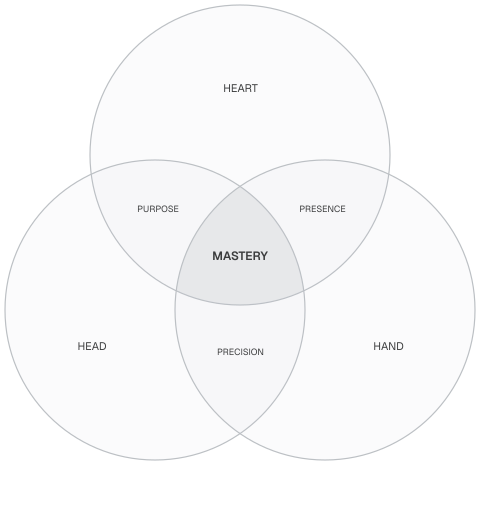
Mastery is the centre of the triangle, Purpose, Presence, and Precision alive simultaneously in the same practitioner, deployed in the same work. It is one of the rarest states in design practice, the one most often claimed and least often achieved.
Mastery is not perfection in each mode. Most practitioners who reach Mastery do not have equally developed Hand, Head, and Heart. They have one or two strong modes and the conscious capacity to reach into the others when the situation requires. Mastery is also not a permanent state. A senior practitioner operates in Mastery during specific periods, on particular projects, and operates at the intersections (or even at single modes) the rest of the time. The popular framing of Mastery, the “triple threat designer” equally fluent in everything, is both impossible to achieve and corrosive to chase.
The working definition of Mastery is consciousness about which mode the situation requires, plus the developed capacity to operate in that mode. The two halves are equally necessary. A practitioner who can recognise that a particular meeting requires Heart but cannot operate in Heart when they enter the room has half of Mastery. The recognition does not produce the capacity. A practitioner who has all three modes developed but cannot read a situation for which one it requires also has half of Mastery. The capacity does not deploy itself. Mastery is the integration of these two: situational reading and modal capacity, in the same practitioner, in the same moment.
The closest analogues outside design are people who must hold multiple modes in real time under pressure, surgeons during operations, conductors during performances, trial lawyers during cross-examination. These professionals do not operate in Mastery continuously. They enter it at specific moments, return to a more localised mode of work, and re-enter it when the situation demands. The myth of continuous Mastery does not survive contact with any serious practice. Mastery is a state a developed practitioner can enter and re-enter as needed.
6.4 — Mastery the centre, all three alive simultaneously · H3